Subsymmetries vs. the "degree of order" (L)
In 2021, Bin Jiang and Chris de Rijke revisited these exact 35 strips with a different, more structured way of measuring how orderly a pattern is. This page explains their idea, shows how it differs from subsymmetry counting, and correlates it against this site's own live data, right alongside subsymmetries.
The critique
Alexander & Carey's subsymmetry count treats every square individually. A run of three adjacent black squares contributes three separate 2-square "subsymmetries" to the total — the same way three isolated black squares scattered through a pattern would. Jiang & de Rijke call this reductionist: it never treats a run of same-colored squares as a single, indivisible unit the way a person actually perceives one.
The alternative: substructures and hierarchy
Their approach — which they call the degree of order (or "degree of life"), denoted L — works differently:
- 1First, merge every run of same-colored squares into one
indivisible brick.
BBBWWWWbecomes two bricks, not seven squares. - 2Recursively decompose the strip into a hierarchy of nested substructures — the whole strip splits into a few pieces, each of which may split further, until every piece is a single brick.
- 3Count the total number of substructures created across every level of that hierarchy (S), and how many levels deep the hierarchy goes (H).
- 4Compute L = S × H. Because a strip can sometimes be decomposed more than one valid way, L is averaged across every valid decomposition.
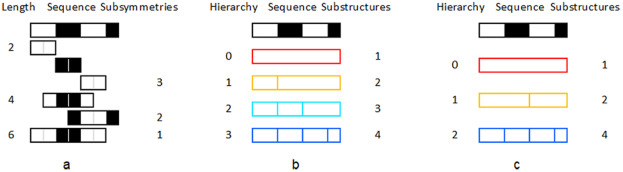
The same strip has 6 subsymmetries by the original count (panel a: 3 of length 2, 2 of length 4, 1 of length 6). Under the substructure approach, one valid decomposition (b) gives L = (1+2+3+4) × 4 = 40; another equally valid decomposition (c) of the same strip gives L = (1+2+4) × 3 = 21. The final L for this strip is the average of every valid decomposition's score.
What we found: L collapses to block count, for this stimulus set
We ran the numbers, and the answer turned out to be more clear-cut than "it depends on the data." Running the ported algorithm on all 35 patterns shows that every pattern's L-score is completely determined by its block count alone — no exceptions, regardless of where the blocks fall or how big each one is:
| Block count | L-score |
|---|---|
| 2 blocks | 3 |
| 3 blocks | 12.0 |
| 4 blocks | 26.8 |
| 5 blocks | 49.3 |
| 6 blocks | 78.3 |
| 7 blocks | 115.7 |
Every 3-block pattern gets exactly L = 12.0, whether it's WBBBWWW or
BBWWWWB or any other 3-block arrangement — L never looks past "how many bricks," for
strips of this fixed length and fixed 3-black/4-white composition. That means, on this specific
35-pattern stimulus set, L-score isn't an independent hypothesis from block count — it's a
monotonic rescaling of it. Any correlation you compute between L and anything else will be
numerically identical to correlating block count against that same thing, which is exactly what the
live numbers below show (L-score's ρ and block count's ρ match to three decimal places).
That connects directly back to the original paper, which already tested block count on this exact data and reported the result plainly:
"if we rank order the patterns according to the number of blocks they contain, this rank order has a correlation of only .198 with the observed simplicity order."
So the fair framing isn't "subsymmetries vs. a more sophisticated hierarchical measure" — on this specific stimulus set it's "subsymmetries vs. block count," which the original paper already tested and moved past. That doesn't mean L is a bad idea in general — it was built for richer 2D and variable-length structures (Jiang & de Rijke's own application is geographic/urban patterns, where block sizes and positions vary far more) — it just means this particular 35-strip, fixed-length, fixed-ratio family may be too constrained a case for L's extra machinery to show any advantage over simply counting blocks.
A different way to read subsymmetry counting
There's a case that Alexander & Carey's original measure captures something L-score's block-count-equivalence (at least on this stimulus set) loses — and it isn't a minor detail. It's worth spelling out precisely, because the effect turns out to be stronger than it first looks.
A solid same-colored block of length n contributes n(n−1)/2 subsymmetries purely from its own internal same-color runs — every sub-run of a solid block is trivially a palindrome. So a block of 2 contributes 1 subsymmetry, a block of 3 contributes 3, a block of 4 contributes 6. Subsymmetry counting doesn't just notice that a bigger block exists — it rewards it quadratically as it grows. That reads like a formal echo of something Christopher Alexander argued throughout The Nature of Order, well beyond this one paper: that small differences in size and proportion produce disproportionate differences in perceived qualities like simplicity, harmony, and "life."
That formula also explains something otherwise easy to miss: BBBWWWW and
WBWBWBW both score the maximum of 9 subsymmetries, but by completely different routes.
BBBWWWW gets there from two solid blocks alone (3 + 6 = 9, per the formula above) — a few
large, self-affirming parts. WBWBWBW has no internal block contribution at all (every
block has length 1, so n(n−1)/2 = 0 for each) — its 9 comes entirely from long-range, cross-block
coincidence: the whole pattern being a palindrome, and nearly every internal window happening to be
one too. That's coherence through fine alternation rather than through mass.
So subsymmetry counting is sensitive to at least two structurally opposite routes to the same perceived simplicity — a few big self-similar chunks, or many small interlocking, resonant parts — and treats them as equally maximal. That fits Alexander's broader insistence that "life" or wholeness isn't produced by one formula, but can be reached by structurally different means. L-score, at least as it behaves on this exact stimulus set, forecloses that: being a strict function of block count alone, it can only ever tell one of those two stories (more differentiation is better) and scores the other (few large blocks) as the worst case, not a second valid path to the same quality.
What Alexander himself said about this data
The argument above was our own inference from the numbers. It turns out Alexander addressed this exact question directly, decades later, in a paper that revisits these exact 35 strips.†
That overlap is not incidental. In a length-3 black block, the two length-2 subsymmetries it contributes genuinely share a square — that's exactly the kind of overlap Alexander's 1965 essay "A City is not a Tree" argues a tree structure cannot represent, and that only a semi-lattice can. A recursive decomposition into non-overlapping substructures — which is what computing L requires — is, in that essay's own terms, a tree. Applied by Alexander himself to this exact case, decades later, the mechanism he reaches for is explicitly the semi-lattice kind: overlapping, not partitioned.
Dimension matters to him here too, not just structure. Elsewhere in the same paper, describing a bench built around a tree trunk, Alexander insists the ring-shaped symmetry of the space around the trunk is already present — "literally, not metaphorically" — in the trunk's actual size and shape, before the bench exists, and calls that statement "the mathematical kernel" of the entire paper. A measure that returns the same score for any two same-block-count strips regardless of their actual proportions is, by that standard, leaving out the part Alexander says matters most.
Even his own LEVELS OF SCALE property — the one closest to Jiang's "scaling law" — turns out to want something different from what "far more smalls than larges" suggests. Alexander defines it as smooth, evenly-graduated jumps between levels (ratios like 2:1, 3:1, 4:1), and warns that big jumps without intermediate levels make coherence "fall apart." Jiang's scaling law instead treats a strongly skewed, Pareto-like distribution as the primary marker of living structure, with the smoother Tobler's law demoted to a secondary, "complementary" role — close to the reverse of the emphasis in Alexander's own definition.
† Christopher Alexander, "Harmony-Seeking Computations: A Science of Non-Classical Dynamics Based on the Progressive Evolution of the Larger Whole," International Journal of Unconventional Computing. The 35-strip discussion appears in the section "Local Symmetry Production," alongside a parallel analysis of the Parthenon.
Live comparison
Computed from the exact same overall simplicity order shown on the report page — same participants, same data, just a different measure of pattern structure to correlate against it. Per the finding above, expect L-score's ρ and block count's ρ to always match exactly for this stimulus set — that's not a bug in the numbers below, it's the direct consequence of L being a rescaling of block count here.
Computing…